Wednesday, May 8, 2013

Days 1 and 2

Day 1 and 2:

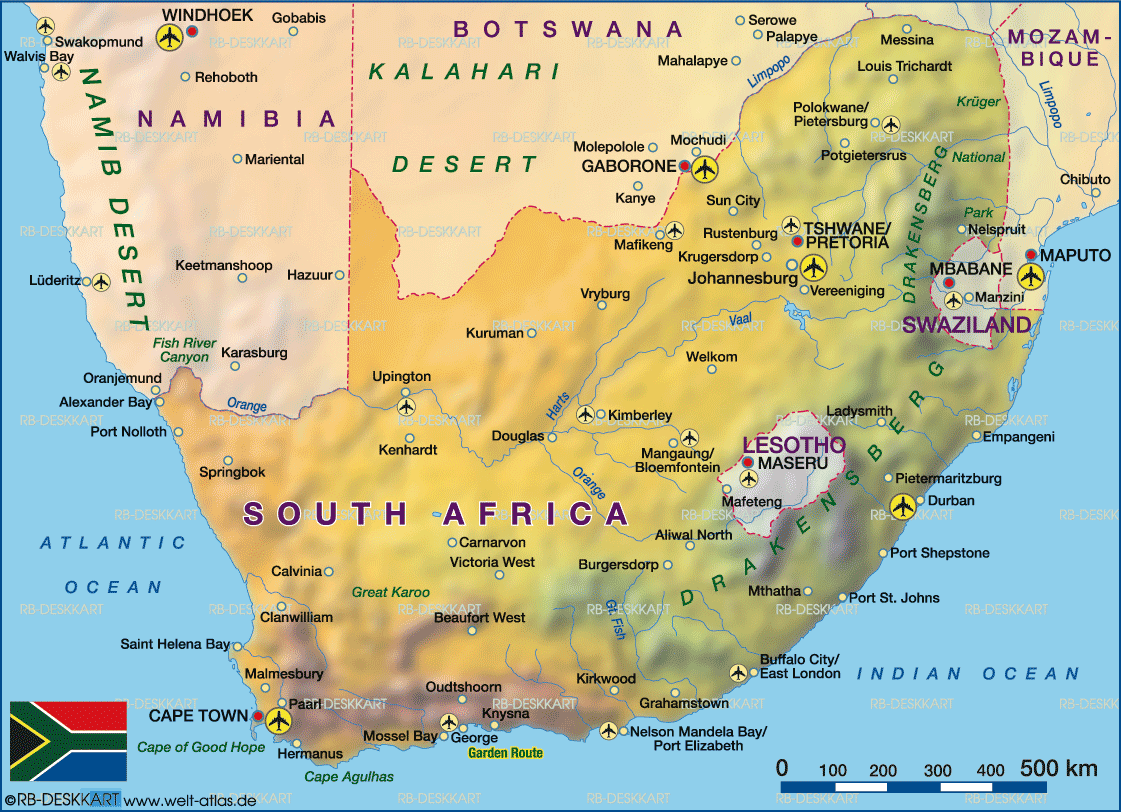
So I combined days 1 and 2 since day 1 is technically the day we arrive in SA and we won't arrive in time to do anything. Yesterday I arrived in Johannesburg Airport and was transported to a guesthouse in Pretoria.  Pretoria is the capital of SA, and this is where we will met our guides and have orientation. 
We slept when we arrived at the guest house, but today (day 2) we have orientation and then we are going to a lion park just outside of Pretoria.  There I will get a chance to bottle feed some baby lions (hmmm wonder how similar it will be to bottle feeding baby raccoons?) and interact with some of the centers other big cats, including king cheetahs!

For those of you who don't know what a king cheetah is, you are missing out. King cheetahs are basically cheetahs that have a genetic quirk in their coat patterns. Instead of having the typical spots they have some spots that look to have blended together creating pseudo-stripes.
    
 When first discovered it was thought that king cheetahs were an altogether new species but a genetic analysis later proved that they are indeed the same species.  I guess you could think of it as the same concept as the white tiger, white tigers are Bengal tiger's who have the recessive gene for white coat pattern. In fact, all white tigers essentially come from the same white tiger who was bred to produce only white offspring.   With the inbreeding and low genetic variability in cheetahs a genetic quirk such as this was bound to show up eventually. 


Monday, May 6, 2013

Goodbye!

I am out of here! I scheduled posts for each day that I am gone telling you all where I am and what I am scheduled to be doing for the day so if you want to know where I am just check back!

Wednesday, May 1, 2013

Diseases and Toxins in Marine Wildlife

Sorry if this comes off seeming like a scare story, it's not meant as one.

While scanning a couple of scientific news sites today I came across a story about sea otter and dolphin deaths.  The story, which you can read here, talked about how new diseases and toxins are affecting marine mammals. These diseases are the result of humans, and although the pollution is often unintended it is still a major problem.

Now, I hope that if you are reading this you happen to actually like and care about animals and just the fact the the pollution is harming and killing these animals is enough to upset you.  However, you shouldn't just worry about the animals health, you should worry about everyone else's as well.  Remember DDT and Bald Eagles? Well, the same thing happens all over the world in every ecosystem.  It's called biomagnification, and it means that a compound increases as it moves up the food chain.

Think of it like this, a pesticide gets spread over some plants.  The grasshopper eats the plants and when he does he happens to ingest some of the pesticide.  Since the grasshopper is immune to the pesticide he survives, but now those chemicals are in him.  Next the songbird eats the grasshopper.  Since the bird has to eat lots of grasshoppers to survive it now has lots of the toxins in it's system.  And it's not just the songbird who eats the grasshopper, small mammals and reptiles do too. However, for this example let's say that the toxin is still not really present enough to harm these secondary consumers. Now, let's think of the  hawk that eats reptiles, songbirds, and small mammals. All of the toxin, in all of these animals, is now built up in the hawk.  Now when the hawk lays its eggs the toxin causes the shells to be thin and the chicks develop with defects or are squashed before the can be born. This leads to a decreasing population of hawks.

It's simple math. You start with the grasshopper equaling 1. The bird, small mammals, and reptiles each eat 20 grasshoppers, so they eat now equal 20.  The hawk eats 20 of them, so the hawk now equals 400.

Now take the examples above and apply it to dolphins or sea otters.  Both of these species eat the same things out of the ocean as we do. If a bunch of fish or oysters are putting so much mercury, bacteria and other toxins into the marine mammals that their immune systems have dropped to the point where they can now get rare diseases, think of what that means for us.

As if it isn't bad enough, those compromised immune systems allow the animals to get diseases that they normally wouldn't. The diseases can then mutate and jump back into land animals and then into humans.  Have you heard of drug resistant strands of bacteria and viruses?  This is caused by evolution and mutation of theses diseases.

So, how did it get there and how do we stop it? Well, the sewage and dumping into rivers and other water systems is one way, but did you know that any road, sidewalk, parking lot, or other paved or compacted soil area will do the same thing? Think about it, if we leave the hose running out over the lawn most of the water is eventually either absorbed by the ground or evaporates up into the atmosphere.  If we do the same thing to the driveway the water either goes down the drain or evaporates out. That water that goes down the drain ends up in a river or stream that then goes to the ocean.  Here you can see biomagnification again where a little bit of toxin and pollutant in one stream joins thousands of streams.

To help with this we need to be more aware of where we are building and what we are destroying.  One way is buffer strips, which are areas of trees and other vegetation that line a water way. This vegetation will slow down and stop erosion and water pollutants if we leave them there. Another is by making sure to leave soil undamaged and uncompacted near waterways.  This will decrease surface run off.

 The last way I want to highlight is through natural filter systems.   Wetlands, marshes, and bogs, things most farmers and developers dislike, work as natural kidney systems that filter out the toxins that are in the water.  Instead of draining them they need to be left in peace to work as they need to.  If you remove one of your kidneys you can survive, but you are limited by what you can do.  If you remove both kidneys you are dead.

So, I'm sorry this one was long but I just wanted to highlight the fact that even though we may not think that we are damaging the environment, we still are. And the next time you look at the amount of money we have to spend cleaning up a polluted area just remember that the environment used to do that for free.

Wednesday, April 24, 2013

Awesome Lunch Break

Today is a perfect example of how you can have an adventure just by sitting at your desk and eating your lunch.

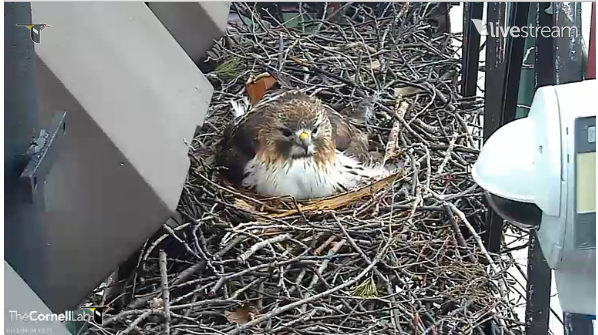
I work for a land conservancy nonprofit called Red-tail Land Conservancy.  Recently my boss, Barry, told me of a live-stream video of a red-tail hawk nest at Cornell University.  Its something I can leave up on the browser and every time I need a break I can simply click over and watch the birds and their chicks. Today I decided to watch them while I ate my lunch (some wonderful shrimp corn chowder) and wow am I glad I did.

You see, today at 12 pm the third and final egg in the brood decided to hatch.  All of us watching were lucky enough that the mom, Big Red, decided to stand up, giving us the perfect view of the chick as it hatched.  I feel very lucky to witness such an event.  I also feel lucky to get to see the other two chicks, who hatched on Monday, interact with their parents, each other, and the third egg. The pictures here are from the live-stream and feature the first 2 chicks with the egg and the top picture is of the dad, Ezra.

Wednesday, April 17, 2013

Elephants and Ivory

In this post I want to touch on elephants and the ivory trade. Ivory was banned in 1979 after a decade of fighting between conservationists and poachers. The war for the elephants was hard and long, but necessary if we wanted to save the elephants from going extinct. When the ban was approved and ivory made illegal everyone heaved a sigh of relief. However, in recent years the elephants have once again dipped into the danger zone as another country rises in power.

The rising economic power in China, and the lifting of the ivory ban there, has once again caused the price of ivory to go through the roof.  Ivory, seen as a sign of economic power and prosperity, was once only held by the wealthy since they were the only ones who could afford it.  Now, as the middle class becomes more wealthy they are demanding more ivory. In China, a country that is steeped in centuries of tradition, it is unlikely they will change their attitudes towards ivory.

All of this means that poaching has once again become a severe problem for the elephants. In recent years we have seen a rise in poachers and a fall in elephant populations.  More and more death sites are being discovered, and although conservationists are back on the warpath, the killing will not stop until the ivory demand is gone.

So how do you help? Well, you can donate to programs like Save the Elephants and help spread the word about how bad ivory is. Everyone has a voice, and it is up to you to make sure yours is heard.

The below video is from PBS and is about elephant poaching and the ivory trade. Warning: there are some disturbing images in this video.


Watch Full Episode on PBS. See more from Battle for the Elephants.


Wednesday, April 10, 2013

Built for Speed

So I thought I'd share a really cool video about my favorite animal, the cheetah.  National Geographic in conjunction with the Cincinnati Zoo and Botanical Gardens recently made a series of videos about the fastest animal alive. In this video you hear two experts' examination of the video. They also name the top three evolutionary adaptations that make the cheetah the best at what it does.

First is the spine. A cheetah's spine is the longest and most flexible of any cat species.  When the cheetah runs the spin works like a spring to propel the cat forward. Its flexibility also allows for compression of the spine without damage.

The skull of the cheetah is also unique. Cheetahs have shorter, lighter skulls which allow them to keep their heads steady as they run.  This allows the cheetah to always keep their eyes on their prey.  Their skulls also allow for larger nasal passages.  This is important because cheetahs, like most big cats, kill their prey by suffocation. With larger nasal passages the cheetah is able to catch its breath much quicker while still maintaining its bite.

The third main evolutionary adaptation cheetahs have is the muscles in their legs, and the ratios of different types. Cheetahs have unique muscle type ratios that allow for a quick and immediate burst of speed.  The cat's can't keep the speed up, but this burst is usually all it takes for the the cheetah to get where it needs to be.

It is clear cheetahs are made for speed.  They may be the low predator on the totem pole (with lions, hyenas, and leopards bullying them around), but they sure can outrun anything. Enjoy the video by national Geographic and the Cinncinatti Zoo by clicking here.

Tuesday, March 26, 2013

South Africa Trip

So on May 6 at 2pm I will be on a plane to South Africa! Well, actually I guess I will be on a plane to Atlanta, where I will meet a connecting flight to Johannesburg, South Africa, but still. Anyways since that is only oh, 42 days or so away I am really excited. I have been going to a class for this trip since January and I have really learned a lot about South Africa and conservation in the country. We have focused mostly on Kruger NP since Kruger has the best documented history and studies.

This trip is what I hope to be the first in many more trips to Africa. I absolutely cannot wait until it is time for this trip, but it's a good thing I have some time since I am still collecting and purchasing the remnants of my gear for the trip. So far for recording my trip I have a camera, a camera trap,a video camera, a couple special tripods, my field journal, field notebook, safari journal, sketch book, and pencils (colored and sketch) and pens. I have bought and received several really great hiking and safari clothes that can be washed in a sink if need be so I am all ready on that front. The only other gear I absolutely need would be my sleeping and washing stuff and since for Christmas I received some really great micro towels and such all I need now is my sleeping bag and pillow. Of course these are some of the largest items I will be packing so that's always fun.

So I have a ton of stuff going with me on this trip, well it seems like a ton but since most of it is small and light weight it packs down really nicely.  Good news is that I plan on keeping all of this gear and using it on all my trips to come, which should be many. I decided to invest in my future so when I bought all my stuff I made sure it was all top quality so that it would last me for years. I also plan to take care of everything because trust me I do not want to repurchase something down the road or worse, have it break when I need it the most.

Be sure to stay tuned as I get closer to my trip!